ABOUT US
MAHA BODHI SOCIETY BENGALURU

Maha Bodhi Society, Bengaluru was founded in 1956 by the Most Venerable Pujya Acharya Buddharakkhita. The objective of the Society is to put into the practice and teach the most sacred and pragmatic teaching of Bhagavan Buddha.
Since its very inception, the Society has been actively engaged in rendering various spiritual and humanitarian services. In keeping with the vision of the founder Most Venerable Dr. Acharya Buddharakkhita, today the Society has expanded its activities in different parts of India and abroad with the message of compassion and unconditional love. Even in his physical absence the most Venerable Acharya Buddharakkhita Bhanteji is the dynamic force behind all the welfare services of the Society, through what he lived, practiced, taught and gave example.
The society has established monasteries for monks and nuns, meditation centers, hospitals, old age homes, educational institutions and published over three hundred Dhamma books benefiting thousands of people around the globe.
We welcome you to participate in our activities and be part of us.
Following programs are run at Maha Bodhi Society, Bengaluru, MBSB
- 1. Mahabodhi Monastic Institute, Bengaluru
- 2. Mahabodhi Meditation Center
- 3. Mahabodhi Academic Studies
- 4. Mahabodhi Maitri Mandala
- 5. Mahabodhi Hospital and Medical Assistance
- 6.Mahabodhi Dayaka Mandali
- 7. Mahabodhi Sunday Dhamma Program
- 8. Mahabodhi Publication
- 9. Mahabodhi Branches
- 10. Mahabodhi Dhammaduta Monks travel
- 11. Mahabodhi Attend our Program
- 12. Mahabodhi Everyday Dhamma
1. Mahabodhi Monastic Institute, Bengaluru
Mahabodhi Monastic Institute is a dedicated monastic training center. It imparts academic and spiritual education to the monks from their young age. The institute provides education similar to the traditional education given during the time of the Buddha and later till the period of Nalanda Buddhist University. The monks are trained in both study and practice of Buddha’s teaching to grow spiritually and thereby to become a guiding light to the world. There are 135 pupils and 16 teacher monks from all over India in the monastery.
- Buddhist ethics and Monastic discipline (Vinaya Pitaka)
- Sutta Pitaka - Discourses of the Buddha
- Abhidhamma Pitaka – Buddhist Philosophical Psychology
- Life of the Buddha and Jataka stories.
- Comprehensive course on Pali language.
- History of Pali language and literature
- Memorization of Pali suttas.
- Buddhist meditation
- Buddhist social philosophy, culture and civilization.
- English, Hindi and Local Language.
- General Knowledge
- Computer Science
- Basic Science, Social, Indian Culture & Mathematics
- Pariyatti Pathama: Secondary school education, from class Six to class Ten, on completion of which Pali School Leaving Certificate (PSLC) is awarded.
- Pariyatti Majjhima : Equivalent to pre-university diploma course.
- Pariyatti Osana: Equivalent to Bachelor’s degree (with the title Dhamma Kosalo)
- Pariyatti Pandita: Equivalent to Master’s degree (with the title Dhamma Pandito)
- Dhammacariyo: Equivalent to PHD (with the title Achariya)
- Anagarika Ordination: On admission they are given Anagarika ordination and candidates will remain as Anagarikas for 2-4 years, depending on their age and learn all the basic things in Vinaya and Dhamma.
- Samanera Ordination: Those who have completed certain level of study and discipline practice get ordained as Samaneras.
- Bhikkhu Ordination: On attaining 20 years of age and completing all the basic studies and practice monks get ordained as Bhikkhus.
The basic training of a Bhikkhu is to follow the Vinaya and go deeper into meditation practice which ennobles oneself and it leads to one’s goal of Nibbana. Other trainings are given as per the temperament and interests of bhikkhus in certain field/s such as
- Meditation practices
- Giving discourses on Buddhism.
- Memorization of suttas and preaching dhamma.
- Monastery management
- Setting up and running Buddhist institutions etc
- Organizing religious events
- Conducting dana services and patient counseling and humanitarian activities
- Buddhist painting and artistic skills
- Guiding Buddhist religious and cultural programs
Mediation is the heart of a monk’s life. Learning without practice becomes only an intellectual activity whereas learning along with meditation helps to grow in wisdom. The monks have to spend certain amount of days every year in meditation at Mahabodhi Meditation Center or some other meditation places and are trained under meditation teachers.
Every day in the morning from 7:15 a.m. to 08:00 a.m. all the monks assemble for discussing daily issues, work and studies. It serves also a time to train monks to give Dhamma talk to a gathering. This program is in keeping with the Buddha’s advice to get together often and discuss issues concerning monastic life and Sangha matters.
Below is a suitable daily schedule followed by monks at MBSB
- 05:00 am Wake up and getting refreshed
- 05:30 am to 06:30 am Puja, Meditation
- 06: 45 am to 07: 15 am Breakfast
- 07:15 am to 08:00 am Monastic assembly and Dhammapada class
- 08:00 am to 08:45 am Cleaning, Decorating and study
- 08:45 am Morning School Assembly
- 09: 00 am to 11:00 am Morning Classes
- 11: 15 am to 12: 00 am Lunch
- 12:30 am to 01:45 pm Rest
- 02: 00 pm to 04: 15 pm Afternoon Classes
- 04:15 pm to 05: 45 pm Tea, Cleaning, Games and Bathing.
- 06: 00 pm to 07: 00 pm Evening Puja and Meditation
- 07:00 pm to 07: 30 pm Gilanapaccaya (Juice)
- 07: 30 pm to 09: 00 pm Studies
- 09: 00 pm to 09: 30 pm Metta Chanting and Instructions by Wardens
- 09:30 pm Rest
Saturday afternoon is reserved for cleaning time in the monastery and dormitories and monks shave and wash their clothes. Sunday afternoon is free time.
Mahabodhi Monastic Library contains good collection of books from all parts of the world written by various well-known Buddhist scholars and writers. The monks are encouraged to study these books and to do research on the Pali canon, Tipitaka, and in other Buddhist fields, i.e., Buddhist History, Culture, Civilization, Traditions etc.
2. Mahabodhi Meditation Center
MAHABODHI DHAMMADUTA VIHARA is a Centre for Moral and Spiritual Education.
This center was started by Most Venerable Acharya Buddharakkhita and he laid the foundation on the occasion of 2250 Buddha Jayanti Celebrations in 2006. The purpose of the center is to run residential courses for meditation and intensive Dhamma studies. The courses aim to teach the moral values, meditation, character building education, personality development programs so that a strong vibrant and patriotic society is built in India.
To learn more about the Meditation Center, please visit our dedicate website.
3. Mahabodhi Academic Studies
Mahabodhi Research Center is offering:
- One Year- Diploma in Theravada Buddhist Studies DTBS.
- 6 Months- Certificate course in Theravada Buddhist Studies CTBS.
- Weekend classes on Saturday and Sunday including meditation, seminars are provided.
Most Venerable Acharya Buddharakkhita started Bhagawan Buddha University to offer proper facilities to study Buddha’s teachings and its implications in a systematic way. This proposed university needs to be developed as early as possible.
The Vision:
To teach and practice the Noble Eightfold Path to progress on the path of enlightenment.
Mission Statement:
To make known the rich heritage of enlightenment bestowed by Lord Buddha 2600 years ago to the present-day world through prevalent methods and thereby spread universal peace and happiness.
Objectives:
- To preserve and offer the pristine pure teachings of Bhagavan Buddha enshrined in the Pali Tipitaka of Theravada Buddhism.
- To offer comprehensive teaching and research facilities to learn Pali, the language used by Lord Buddha, so that the original teachings of the Buddha are made known to the world.
- To offer comprehensive teaching and research facilities to conduct research on the original Pāli Tipitaka and the Aṭṭhakathā, Tikā and other Pali texts – Pariyatti.
- To teach and offer facilities to practice the fundamental teachings of Lord Buddha, namely Sīla, Samādhi and Paññā (morality, meditative concentration and wisdom) – Paṭipatti.
- To translate and publish the sacred Pāli Tipiṭaka, its commentaries and sub-commentaries in different Indian and international languages.
- To teach meditation and to organize meditation courses, camps, retreats, etc.
- To organize seminars and conferences on various issues concerning Pali, Buddhist philosophy, the Tipitaka, the relevance of Buddha’s Teachings to modern life and development and practical application of the teachings of the Buddhism in as many modern fields as possible.
- To formulate and prepare teaching materials for the study of Pali and Theravada Buddhism from primary school to university levels.
- To promote a peaceful, contented and spiritually oriented society which contributes to world peace and happiness of all beings.
The Bhagavan Buddha University, which is presently being developed as a center of learning for Pali and Theravada Buddhism will also have collaboration with other educational institutions of repute, both from India and abroad. It is the responsibility of one and all to take this mission further and make it success.
4. Mahabodhi Maitri Mandala
Mahabodhi Maitri Mandala (MMM) Bengaluru was founded in 1957 by the Venerable Acharya Buddharakkhita. The aim of the MMM is to put into practice ‘Compassion in Action’ inspired by the Lord Buddha’s life and teachings followed by so many great personalities.
Since beginning the MMM has been engaged in several medical, social and educational activities. The founder Venerable Acharya Buddharakkhita was a dynamic personality who worked very hard to remove the sufferings of the people. Major among them is the building of the Mahabodhi Burns Hospital in the Victoria hospital complex in Bengaluru. MMM is running 6 Schools and 1 college to give education to thousands of poor children from all background without any partiality. Mahabodhi Karuna Charitable Hospital and Mahabodhi Old Age home in Arunachal Pradesh State are successful program benefiting hundreds of people.
5. Mahabodhi Hospital and Medical Assistance
Mahabodhi burns and casualty center is dedicated to the service of burns patients which is one of the biggest in India. Today it houses and treats hundreds of burns patients. It is situated in Victoria Hospital complex in the heart of Bengaluru city and is managed by the Government of Karnataka.
The monks and lay devotees of Mahabodhi Society visit the hospital every month and distribute fruits, buns etc., to the patients and provide counseling to the patients and relatives.
The hospital Dāna service was started by Bada Bhanteji way back in 1956 when he saw the suffering of people in Victoria Hospital. It is one of the earliest programs of MBSB. This program is one of the closest to our founder and as well it touches the life of many needy people. Even today the Dana is practiced with joy to demonstrate ‘compassion in action’. Every Purnima – full moon day the monks visit Hospital with fruits packets and other essential relief materials to give to poor patience at Victoria Hospital. Monthly once or twice nutritious lunch is offered to 350 poor cancer patients at Kidwai Cancer Hospital, Bengaluru.
Mahabodhi has supported many poor people to receive medical support. During the natural disasters or difficult times, Mahabodhi always does its best to help as many people as possible. Due to Corona virus crisis thousands of people are getting relief materials through Mahabodhi.
Venerable Acharya Buddharakkhita was determined to build a hospital with the concept of holistic medicine in Jayanagar Bengaluru. He built Mahabodhi Arogya Hospital which has served countless people. Work is going on to expand the services giving more facilities.
Mahabodhi Karuna Medical Center is running offering free medical care to the needy since 45 years. In earlier years it was artificial limb center where limbs were manufactured and donated in the villages. Today with modern technology 3D prints of limbs are made and offered. Medical camps and student health program are run under this center.
Diyun is one of the remote areas of Arunachal Pradesh and the CHC is not adequate to care the densely populated area. Even for small ailments poor people had to hire taxi and travel three hours to Tinsukia. Therefore, Mahabodhi Karuna Charitable Medical Center was started in 2014. Since then thousands of people are getting treatment and it is open 24 hours 365 days. The minor operations and child deliveries and also conducted here. Only complicated cases are referred to bigger cities. Those interested may help to extend our services.
6. Mahabodhi Dayaka Mandali
Dhammacaris are the lay people who follow the sila well, practice meditation and selflessly dedicate lot of their time for community services. In the absence of monks most of the places need a guide and leader to conduct ceremonies and organize programs. And even if monks are there kappiyas, assistants are needed to deal with certain household issues. The Dhammacaris serve as such organizers, guides, mentors, leaders. Courses are conducted to train the Dhammacaris, so that good moral and spiritual householder kalyanamittas are available for people in need.
Important days related to the life of the Buddha like Buddha Jayanti (Vaishakha Purnima), Dhammacakkha Day (Guru Purnima), Pavarana Day (Ashwini Purnima) and other festivals are celebrated with meaningful programs at Mahabodhi. The birth anniversary of Ven.Acharya Buddharakkhita is celebrated as Dhammapada Festival (Phalguna Purnima). After the Vassa- three months rains retreat after Ashwini purnima one day Kathina festival is organized to offer the Kathina robe and other needs of a monastery. Sometime night long paritta chanting and meditation organized for the welfare of all beings.
It is very important as follower of Lord Buddha to put compassion in practice. When so many people are suffering, it is a great spiritual practice to share, small or big, with the suffering people. Normally Mahabodhi responds to natural calamities and now in situation like Corona problem. You are most welcome to join our relief programs either by donating or by volunteering. Or if you wish we can organize a relief camp for a specific purpose.
7. Sunday Discourses - Dhamma Dana Program
Sunday Dhamma discourse program was started by the Venerable Acharya Buddharakkhita from the very early stage of his arrival in Bengaluru way back in 1956 and it has been continuing without a break from that time. Every Sunday Upasakas and Upasikas assemble at 9.30 AM in the Mahabodhi Loka Shanti Buddha Vihara and participate.
The program is :
- 9:30 AM - Assembling in the Dhamma hall, offering of flowers, lamps, incense and Buddha Puja
- 10:00 AM - Undertaking of Tisarana and Pancasila
- 10:05 AM - Meditation (normally guided by a monk)
- 10:30 - Dhamma discourse in English based on a sutta or relevant topic by monks
- 11:05 - Sharing of merits and blessing to the people or any special ceremony and metta chanting
- 11:15 - Sanghadana - offering lunch to the monks and benediction
- 11:45 - Lunch for lay people
- 12:30 PM - Dhamma Discourse in Kannada language by the monks
- 1:30 PM - Conclusion
Dhamma Study Classes
For those who want to study and go deeper into the Buddhist philosophy and psychology, Pali language and literature, classes are conducted by experts. Every Saturday and Sunday from 1 PM to 5 PM classes are held on the subjects like Suttas, Pali, Abhidhamma. Occasionally seminars are arranged.
8. Mahabodhi Publication
The Supreme Buddha gave his teachings in the standard vernacular of the day, in Pali language. These teachings are preserved in the original Pali language to this day in the form of Tipitaka – The Three Baskets of Vinaya, Sutta and Abhidhamma. The commentaries (Atthakatha) and sub commentaries (Tika) are also in Pali language. This Pali literature is not just the teachings of the Buddha, but they are great store house of information about the life and society 2500 years ago. Even from sociological and historical perspective it is absolutely necessary to study these texts to get clear pictures of our great India in olden time.
One of the most ambitious projects taken by MBS is to translate this huge volume of scriptures into Kannada, Telugu and other major Indian languages. We are very glad to inform that 29 volumes have been published in Kannada and 13 in Telugu. The specialty of these holy books is that they contain the original Pali text in Kannada and Telugu script on one side and the translation of the same on the other side of a page. Like that the original teachings of the Buddha are available in both its original Pali form as well as translated form.
We are immensely grateful to the Governments of Karnataka, Andhra Pradesh and Telangana for their support to bring out this precious works in the respective languages. Such valuable knowledge enriches the languages it is presented in.
Buddha Vachana Trust is as associate of MBS and it has been publishing hundreds of books, mainly written by Most Venerable Acharya Buddharakkhita and other authentic Theravada Books. Since inception more than 300 books have been published and distributed by the Trust.
Mahabodhi Media Center is a part of BVT. Dhamma talks in English, Hindi, Kannada and other languages are bought out in digital formats and are distributed and presented on different platforms. You can also find most of the talk on our YouTube channel.
BVT has setup a noncommercial BUDDHIST SHOP with collection of Buddhist books, Statues, Posters, Paintings, Flags and Gift items and other puja items. One can order online or contact the manger.
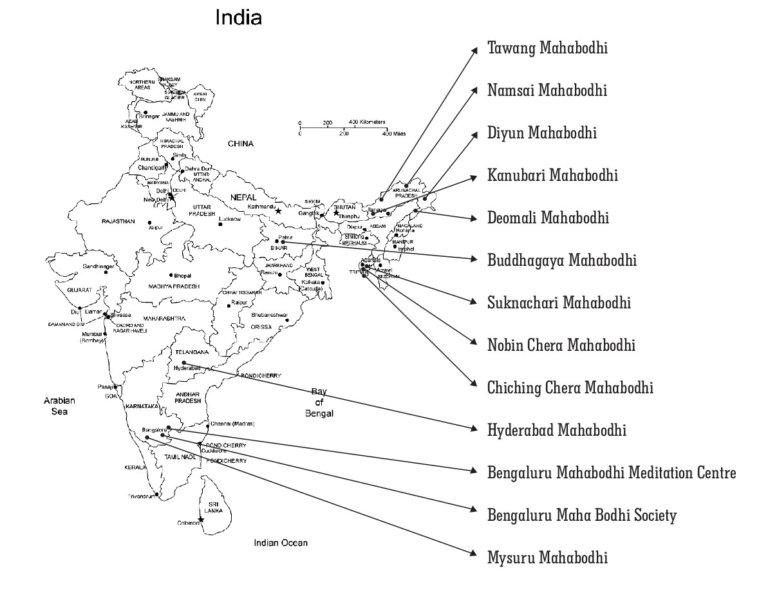
9.Mahabodhi Branches
1.Maha Bodhi Society, Bengaluru Head Office.
Mahabodhi Monastic Training Center, Meditation Center, Publications, Dhamma Classes, Hospital Dana services, Sunday Discourses, Meditation Retreats, Cultural programs, Buddhist Study Programs.
2.Mahabodhi Meditation Center, North Bengaluru.
Intensive Courses - 1 to 3-month meditation retreats, Short- 5 days, 7 days, 10 days meditation courses, Temporary monkhood programs, Dhamma Classes, 1 day meditation workshops for professionals, college and school students
3.Mahabodhi Mysuru
Mahabodhi School, Carla Students Home, Mahabodhi Mettaloka Youth Center hostel for university students, cultural programs
4.Mahabodhi Hyderabad
Mahabodhi Monastic Training Center, Meditation Center, Publications, Dhamma Classes, Hospital Dana services, Sunday Discourses, Meditation Retreats, Buddhist Study Programs, Annadanam project
5.Mahabodhi Diyun, Arunachal Pradesh (AP)
Mahabodhi School, Mahabodhi Rita Girls Home, Boys Home, Monastery for monks, Agriculture program, Mahabodhi Karuna Medical Center, Dairy Program, community development program, moral education program
6.Mahabodhi Namsai, AP
Mahabodhi Lord Buddha College, Mahabodhi Maitri Students Home, Mahabodhi Monastery for monks, Skill programs
7.Mahabodhi Nongtaw, AP
Mahabodhi Skill Development, agriculture and horticulture program, animal welfare program, environ protection program, forest meditation center, nature study and preservation program
8.Mahabodhi- Tawang, AP
Mahabodhi Home for Elders, Mahabodhi Girls hostel, Mahabodhi Boys hostel, Mahabodhi School, Ven.Acharya Buddharakkhita Students Home, Mahabodhi Positive Living Center, Hospital Dana services, Dhammika Stupa, Mahabodhi Dhammakhetta center, Village counseling programs.
9.Mahabodhi Deomali, AP
Mahabodhi Boys Home, Culture development program, Rural development, Mahabodhi Meditation Center.
10.Mahabodhi Kanubari, AP
Mahabodhi School, Mahabodhi Children Home, Mahabodhi meditation center, counselling
11.Mahabodhi Suknachari, Tripura
Mahabodhi School, Mahabodhi Boys Home and Girls Home, Mahabodhi monastery for monks, Meditation center, Pindapata program in villages
12.Mahabodhi Chichingchera, Tripura
Mahabodhi School, Mahabodhi hostel for boys, Mahabodhi Monastery, village centers.
13.Mahabodhi Nobinchera, Tripura
108 World Peace Buddha Statue project, Life of the Buddha Museum project, Forest meditation Center, community welfare programs
14.Mahabodhi Meditation and Cultural Center, Bodhagaya, Bihar
Meditation courses, pilgrim house, Mahabodhi stupa, rural relief programs.
10.Mahabodhi Dhammaduta Monks travel
Lord Buddha suggested
"Go forth, o bhikkhus, for the good of the many, for the happiness of the many, out of compassion for the world, for the benefit, for the good, for the happiness of gods and men. Let not two go by one way. Preach the doctrine that is beautiful in its beginning, beautiful in its middle, and beautiful in its ending. Declare the holy life in its purity, completely both in the spirit and the letter.” ~ Mahavagga, Vinaya Pitaka."
The monks of Mahabodhi travel to different part of India and abroad to teach the Dhamma and spread the message of peace and compassion. This helps monks also to learn and experience more by going through all kinds of difficulties of travel, stay, food and different people. For people they receive the Dhamma and countless people express that their lives have been changed. It is good for one and all.
11. Mahabodhi Attend our Program
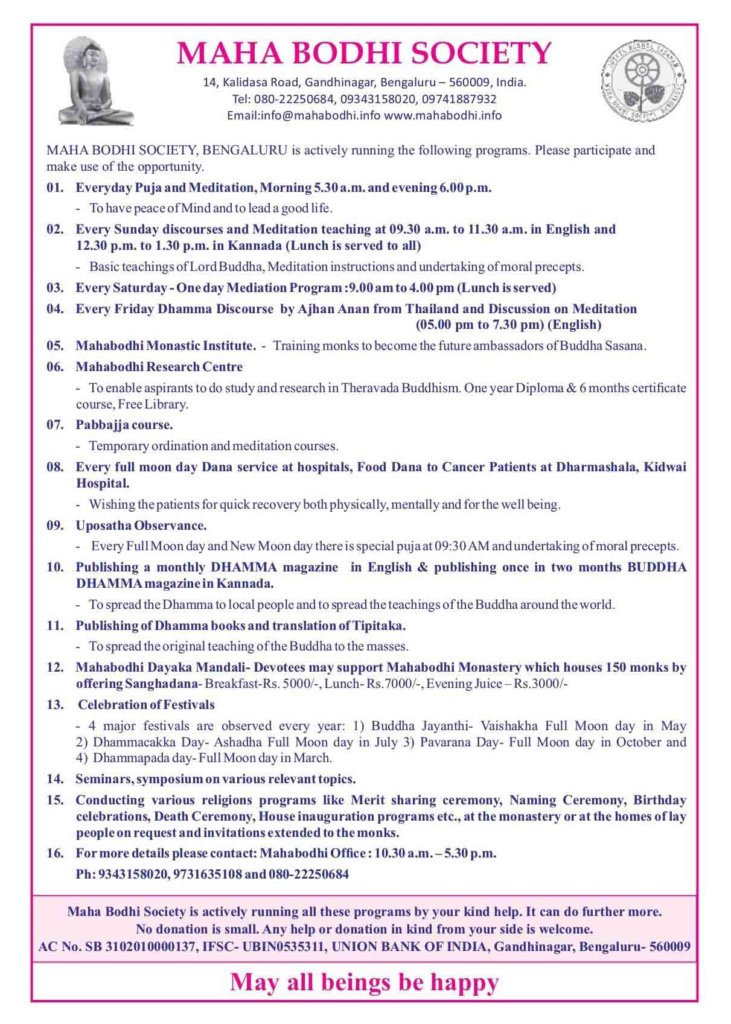
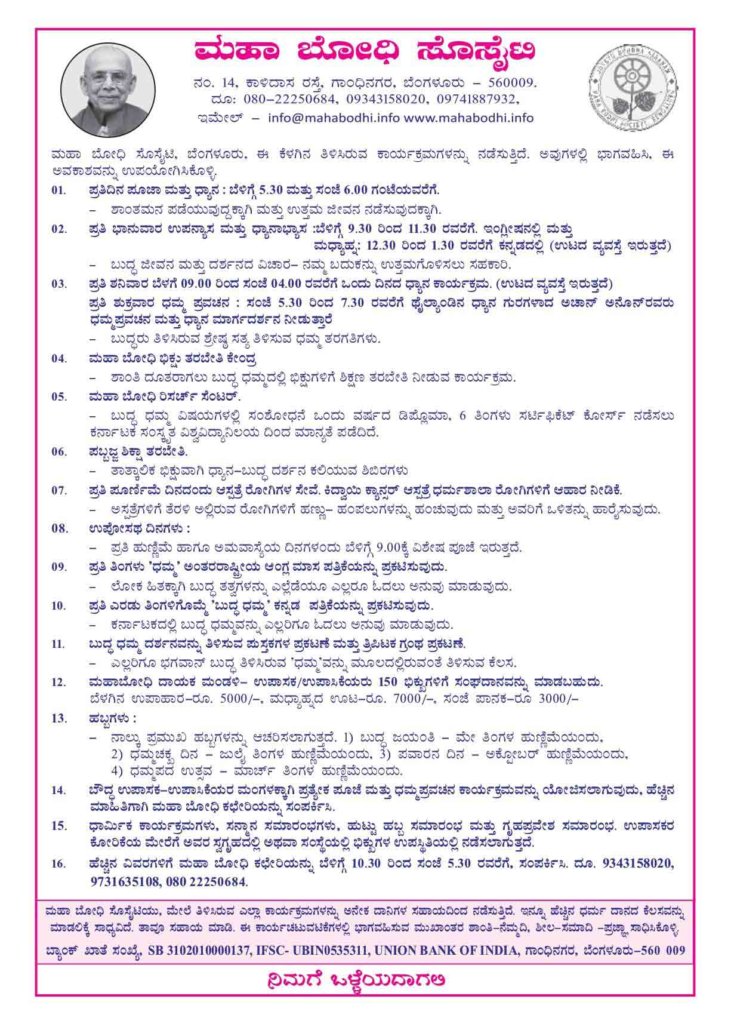
All are welcome to participate in all our programs regardless of religion, race, colour or sex etc.
Everyday Programs:
- Morning Chanting and Meditation at 5:30 am.
- Evening Chanting and Meditation at 6 pm.
If you are looking for a place to practice your daily meditation. You are welcome to use the meditation hall from 7 am to 8:30 pm.
11. Mahabodhi Attend our Program
EVERYDAY DHAMMA
SHORT GUIDELINES FOR LEADING A SPIRITUAL LIFE
A Lotus grows out of the mud, yet its flower remains untouched, unaffected, unstained by the dirty mud and stagnant water. You are lay people; you live in the world and yet you can lead a spiritual life. It is spiritual values that bring real beauty, colour and fragrance to human life. Without spiritual values, human life is like a flower tree, without flowers!. Come, come my dear friends, come and plunge into the Spiritual life and realize the nature and beauty of life. Come, come, O! Travelers come and meditate seriously. You will cross the ocean of darkness and ignorance and will reach the light of truth.
DAILY MORNING:
- 10-15 minutes of recitation of Buddhist devotional chants.
- Undertaking Panca Sila, the 5 basic moral precepts, with full understanding.
- I love all beings and refrain from harming or killing any living creature.
- I share and give and refrain from taking what is not given to me.
- I uphold the dignity of partnership and refrain from adultery.
- I speak truth and meaningful things and refrain from speaking lies.
- I create clarity of mind and refrain from consuming intoxicants which confuse the mind. The moral precepts are the very foundation of spiritual life; no spiritual progress is possible without a strong foundation of morality.
- 30 to 60 minutes of meditation (Samatha/Vipassana). Meditation practice is the very core of spiritual life. It is not possible to realize the Ultimate Truth without regular and proper practice of meditation. “What sun is to flowers, meditation is to the mind”.
- 5 minutes of Metta (loving-kindness) meditation. Love is blissful, love unties, love elevates and love cures that most malignant of diseases, hatred. Develop pure love for all beings. Give love, live in love, fill your heart with compassionate love. Love is a panacea for all the ills of life. When your heart is full of love, the world is full of love. Radiate the brilliant light of love in all directions, outwards and unbounded.
DAILY EVENING
Before going to sleep, meditate for 30 minutes. 15 minutes of reflection and assessment of the day – recognizing the unwholesome and rejoicing in the wholesome Kammas/ Actions performed during the day. 5 minutes of reflection on the five realities of life – Old age, sickness, death, changefulness of all people and things and kamma. 10 minutes of Metta meditation.
WEEKLY
Lead a holier spiritual life by
- Participating in one full day meditation retreat.
- Observing the 8 precepts on the full moon day, new moon day or on Sundays or holidays convenient to you.
YEARLY
- Lead a holier and richer spiritual life by participating in one or two 10-day intensive Meditation retreats. As you make progress in your meditation practice, you should try to devote more time to it.
- Offer Sanghadana in the monasteries along with family members.
- Take up temporary Pabbajja ordination and enjoy the life of freedom in monasteries.
- Participate actively in the Buddhist festivals and contemplate on the qualities of the Buddha, Dhamma and the Sangha.
- Volunteer in the monasteries or other places and render selfless service for a period of 5 days or more
- Follow the noble Eightfold Path and develop the ten Paramis (perfections) – the basic requirements to achieve Nibbana, step by step, little by little, and day by day.
FULL MOON DAYS
Full moon days are very special for the seekers of truth and lovers of peace. Try to sit for a longer period of meditation. Try to observe the 8 precepts seriously. Try to eat only one meal. Try to donate in charity the money you could have spent or the meals that day.
CHARITY
Practicing Dana/ Charity is an important aspect of spiritual life. Try to give 5-10 percent of your income to the monks and monasteries or for the welfare of the poor, sick, elderly, orphans, handicapped and the other unfortunate ones. All beings depend on each other. All beings are related in some way or other. Your earnings depend on others, no matter how hard you work and how honestly you earn your money.
PILGRIMAGE
It is important for all seekers of truth and lovers of peace to undertake pilgrimage to the holy places – Lumbini, Buddhagaya, Sarnath, Kushinagar, Savatthi, Nalanda, Rajagaha, Vaishali, Sankissa, etc. These places are inspiring and take us to the presence of the Buddha as they are historical remains connected with the Buddha’s life. As the Lord Buddha said in the Mahaparinibbana Sutta, one should visit these holy places at least once in a life tike. But visiting them often is still better, particularly under the guidance of an experienced teacher with good prior preparation and with full understanding of the significance of the pilgrimage.
SUPPORTING THE HOLY SANGHA
Try to support the members of the Holy Sangha. The Holy Sangha has preserved the precious teaching of the Buddha. Their material needs are totally dependent on the generous offering of lay devotees.
TIME IS PRECIOUS
Try to cut down on gossiping, watching television programmes and non-essential reading. Try to develop the habit of reading Dhamma books. Do not waste your precious time. Make the best use of what remaining time you have in your life. There is no time to lose; Death is coming closer and closer. The ticking of the clock reminds us of the fast approaching footsteps of Death!. Save time for your Spiritual Life.
WORK IS WORSHIP
Perform your official duties as part of fulfilling the 10 Paramis (Perfections). Take your work as worship, Kamma as Dhamma. Your daily duties should be an expression of your true love and respect for others.
COMPASSION IN ACTION
Service to others brings out all that is great in man. It broadens the heart and widens one’s vision. It fills one with joy. It promotes unity. Human life is meant for self development and service to others. Whatever talent a person has should be dedicated to the service of humanity, for the benefit of all living beings. There lies fulfillment of compassion. Whenever calamities, such as earthquakes, floods,etc. occur, try to come forward and join relief campaigns with a sense of compassion and sympathy. Hate none, love all, serve all and feel oneness with all.
RARE OPPORTUNITY
After obtaining this precious human life, no self-deception could be worse than not using it for meditation, for the realization of truth. It is so hard to gain good human life and it is easy to get it destroyed in no time. Take full advantage of this precious human birth.
AWAKE !!
Oh friends, undertake vigorous meditation. Make your spiritual life as much a part of your daily life as eating, drinking and breathing. Extinguish all the impurities of the mind and attain the brilliant illumination of truth through meditation. Regular meditation alone can bring you true happiness.
Awake!
Do not postpone. What should be done for you, out of pity, by a compassionate Master, who seeks your welfare and has pity for you, has already been done by the great compassionate Buddha. He says‘Do not delay, lest you should regret it later. Out of love, this is our message to you’ . Here are the opportunities, learn and develop meditation, my dears!
REWARDS OF YOUR SPIRITUAL LIFE
You will live in peace and harmony here and now and you will generate peace and harmony for others. You will be protected from all harm and dangers. People will love and support you. You will die peacefully with no regrets or fear. If you do not achieve full liberation in this life, you will be reborn in a higher and happier realm of existence.
!! May all beings of happy!!!
Venerable Bhikkhu Sanghasena
- 1. Mahabodhi Monastic Institute, Bengaluru
- 2. Mahabodhi Meditation Center
- 3. Mahabodhi Academic Studies
- 4. Mahabodhi Maitri Mandala
- 5. Mahabodhi Hospital and Medical Assistance
- 6.Mahabodhi Dayaka Mandali
- 7. Mahabodhi Sunday Dhamma Program
- 8. Mahabodhi Publication
- 9. Mahabodhi Branches
- 10. Mahabodhi Dhammaduta Monks travel
- 11. Mahabodhi Attend our Program
- 12. Mahabodhi Everyday Dhamma