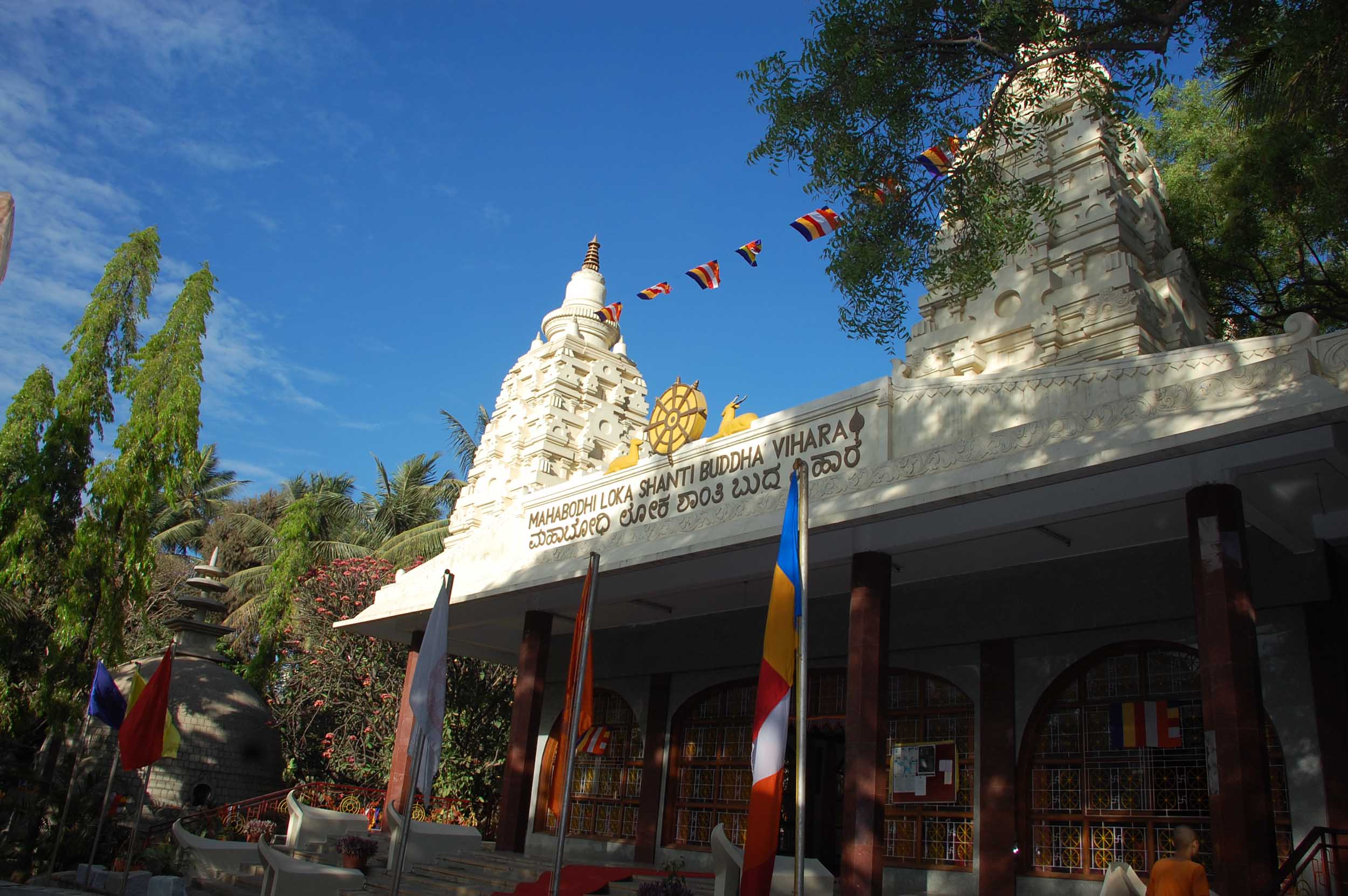
Maha Bodhi Society, Bengaluru, was founded in 1956 by the Venerable Acharya Buddharakkhita. We are happy to produce here the speech given by our founder on ‘The History of the Maha Bodhi Society Bengaluru’ on the occasion of the Annual General Body meeting of Maha Bodhi Society held on 21-05-2010

Dear Members And Devotees,
"May the blessings of the Buddha surround your lives with well-being and wisdom!"
Maha Bodhi Society, Bengaluru, was founded in 1956 by the Venerable Acharya Buddharakkhita. We are happy to produce here the speech
Maha Bodhi Society, Bengaluru, was founded in 1956 by the Venerable Acharya Buddharakkhita. We are happy to produce here the speech
Maha Bodhi Society was founded by the Venerable Anagarika Dhammapala of Sri Lanka in 1891. He
hailed from an aristocratic Sinhalese Buddhist family. Once he visited India as a pilgrim to
worship the holy places associated with the life of Lord Buddha. When he visited Buddha
Gaya, there was nothing there except broken images and the temple built by Emperor Ashoka
was dilapidated and broken. It was turned into a Devalaya for various gods. The Mahant had
occupied it illegally and since the place was covered with jungle nobody cared. He regularly
and systematically exploited the foreign Buddhists from Sri Lanka, Burma and Thailand and
Himalayan regions where lots of Indian Buddhist followers lived. Since Venerable Dhammapala
objected to the desecration of Lord Buddha's images, he was badly ill-treated by the goondas
of the Mahant.
So he went to the Bodhi Tree which was in a pitiable state uncared for
and almost drying up. At the foot of the Bodhi Tree he took a vow of protecting the Holy
Buddhist place by starting the Maha Bodhi Society to fight for the cause of restoration of
the holy places and dedicated his whole life to this one single goal. He wanted to revive
Buddhism through restoration of Buddhist sites to Buddhists. He started a movement where
very eminent leaders of Bengal like Sir Ashutosh Mukharjee, Sir Manmatha Banerjee, Shri
Shyama Prasad Mukherjee, etc participated and actively helped the Anagarika.
He went
to various foreign countries including the US. He attended the Parliament of World Religions
in Chicago in 1893. Returning to India he was able to get enough fund to start the Calcutta
Maha Bodhi Society with a good piece of land and later on a building. He brought young men
from Sri Lanka and made them monks and trained them to run pilgrim centers in various holy
places. These young monks, fired with the zeal of Venerable Anagarika Dhammapala, worked
hard. But they had no idea of propagation of Buddhism in the Indian context, so that
Buddhism could grow in India and in a real way bring about revival of Buddhism in India, the
land of its origin.
I visited the Maha Bodhi Society Calcutta in 1946 and took the
pancasila, being much impressed by the teachings of Lord Buddha. Later, in 1949, when I
became a Buddhist monk at Kusinara under the Most Venerable Candamani Mahathera, I resumed
my contact with the Maha Bodhi Society in Saranath, Calcutta and in Colombo where I had gone
to study Buddhism under the Most Ven.Nyanatiloka Mahathera of Germany and others. After
completion of Buddhist monastic education I was invited by the government of Burma to
participate in the editorial work of the Tipitaka as a Pativisodhaka.
Later at the
invitation of Venerable Jagadish Kashyap I joined Nalanda Pali Post Graduate Institute to
teach Abhidhamma. So these associations taught me the significant lesson that the revival of
Buddhism in India, the most vital task for every Buddhist, will remain unfulfilled unless
there are really dedicated Indian Buddhists. Bhikkhus from various Buddhist countries were
sincere but their activities were limited to managing the foreign pilgrims from various
countries. Some Bhikkhus became teachers of Buddhism as part of Indian philosophy in some
universities. All these activities were non-productive from the point of revival of
Buddhism. They had cosmetic effect, and were superficial and unsustainable.
On the
occasion of 2500 Buddha Jayanti I decided to resign from Nalanda Post Graduate Institute,
went to Buddhagaya to meditate and offered one lakh deepa puja for one full month. I got a
clear mind about future activities. That is how, when Mrs.Bianca Moonasinghe the niece of
Venerable Anagarika Dharmapala, and the wife of the General Secretary of Sri Lanka Maha
Bodhi Society, and the head of Mahabodhi ladies committee, approached me saying that she got
some land given by Maharaja of Mysore which was lying idle and some people had encroached on
the land and nothing is happening, etc. I accepted the offer with the condition that I will
not be another bhikkhu employee as in other centers of Maha Bodhi Society. Ours will be an
independent society, and as president I will conduct activities in a practical way through
seva and sadhana programs. She was more than happy and that is how I came to Bangalore on
5th June 1956.
On arrival I found the Mahabodhi site was once a part of the central
jail as a stone quarry with 20-30 huge pits. Jail inmates were made to break the stones as
punishment. I was faced with the gigantic task of filling up of the whole area with garbage
which was done partly before, and starts the building work which was also partly in
progress. We began by putting a compound wall, removing encroachers, who had turned the land
into public latrine, and started planting Ragi to make the land fertile. So the first few
years, it was development of the site and building work.
Now this year is the 54th
year since the inception of the Maha Bodhi Society, Bangalore, and it will be appropriate to
present a bird's eye view account of all the developmental activities up to date. For the
sake of brevity the 54 years have been divided into 6 Navakas, periods of nine
years.
In the first Navaka (1956-1965) the activities were varied and even colorful.
In the first week of arrival somebody came and gave me a copy of Deccan Herald. The
gentleman was one Mr.Basu whom I knew. The paper had painted me rather black saying, here is
a Buddhist missionary, an ex Hindu sanyasi, with the sole object of converting people into
Buddhism, etc. Six or seven intellectuals from local colleges came and said that they read
the news and wanted to have a debate. I accepted the challenge and we debated near the
present Bodhi Tree. At the end all were convinced that what they read was false and they
were sorry for troubling me.
With these few intellectuals I started the Sunday
Discourse Program, with half-hour meditation, and Dhamma teachings. Later on through them a
lot of others joined and the program has continued since then. One day visiting Victoria
hospital I saw a large number of cancer patients waiting for the doctor. They were in pain.
So I decided to start a seva program and called it Hospital Dana Service.
Nearby
there was the wholesale fruit market. A man had Coorg oranges and bananas in heaps. When I
asked him the price he questioned why as monk I needed so much. I told him that I want to
give dana in hospital to the patients who are suffering. That shopkeeper said ok and gave
the Coorg oranges and bananas and did not take any money. He also arranged for a coolie who
too did not take money. When I went to Victoria hospital the chief doctor asked why did I
bring so many fruits, I told him the purpose and he arranged for the distribution to 3-4
wards. The fruits were distributed and we wished the patients speedy recovery with the
blessings of Lord Buddha. The doctor also promised money for the next service.
As a
part of educational program, we organized some medico-social-service courses in which many
ladies took part and later ran hospital library service programs. We collected books to be
kept in hospitals for patients and attendants to read. One day a gentle man came and said
that he had extra tempos and wanted to offer two tempos because he had seen us going to
hospitals on jhatkas everyday. Since we didn't have money to appoint a driver, and I knew
driving anyway, I got a license with the help of a devotee and started driving. The hospital
service became well organized. We took up special services like leprosy patient’s service,
cancer patient’s service etc. Later an eye donation program from Sri Lanka was added. These
services spread wider, lot of people participated and there was no dearth of
funds.
Meanwhile when the ground floor work of the main building was completed we
took up the first floor. And so the construction project too progressed and a lot of people
joined for monastic training program.
Another interesting instance may be mentioned.
Mr.Nijalingappa while he was Chief Minister became a close devotee. He was in hospital as he
was sick. He had seen our hospital dana service and we had met him in the hospital. It seems
some industrialist wanted to bribe him with a car for getting a license for his industry.
He, a clean-handed politician, threatened the man that he will be sent to police.
Frightened, that man asked for forgiveness. Mr.Nijalingappa told this man that he will be
forgiven if he gives away that car for hospital dana service conducted by Maha Bodhi
Society. That is how the first four wheeler came to MBS.
In 1960-62 there was a
famine, no rain for three years. The Indian and American governments had entered into an
agreement called PL480 food-aid program for distressed people in famine affected areas. Now
huge quantities of burgler wheat, oil, etc. arrived in Bangalore and were given to
missionaries to distribute. They took advantage of this and converted lots of poor people
around Bangalore. One day one Rama Reddy came, whom we I had seen as a patient in Victoria
Hospital. He literally cried saying his village is going to be converted as the tank dried
up totally and people had started eating even grass seeds. He asked if Mahabodhi could take
up some seva program. So we went to Victoria and discussed the matter with doctors and very
soon we started a rural medical seva program. On return from Sakalavara we visited the Chief
Minister and described to him about the pitiable situation in the entire Bannerghatta area.
He spoke to Dr.Alva, minister for health, and we organized a big medical service program and
started to distribute PL480 food stuff. When famine abated, we thought of withdrawing from
the area when our work was finished. But people requested Mahabodhi to stay and gave 13
acres of land and we started the Mahabodhi Rural Medical Center, Sakalavara, to render
medical and humanitarian services. As it was being planned Mr.Birla offered to give money.
We prepared a project report and needed Rs.75000 for the building. But he gave one lakh
saying we will need more. At Sakalavara center we also started a student’s horticulture
course and various other programs such as the ‘Scheduled-caste Housing and Welfare program’.
The government gave a grant to build 20 houses to 20 very distressed families, together with
a coconut tree and a cow each. The government also gave funds for road. When Sakalavara
project took full shape, the government of India came into the picture through NIMHANS and
they offered to expand the services to 45 villages, from the present 4 to 5 villages. By the
end of 1st Navaka Maha Bodhi Society programs expanded on their own. Money came, people came
and things happened.
In the 2nd Navaka we thought of concentrating on burns patients.
There was no burns hospital in Karnataka state. Burns patients were put in the varanda of
the Victoria hospital and nothing could be done except to let them die. It was a saddening
situation. So the Mahabodhi promoted a Burns Hospital Project. Various industrialists
donated as we offered free service to the industrial accident victims. We started with 50
beds which later on became 200 beded hospital. It was named Mahabodhi Burn’s and Casualty
Center. Later on this program was further extended. We built Burn’s Wards in several
district hospitals, such as, in Mysore, Mandya, Hassan, Tumkur, Chikmagalur government
hospitals. It became a highly satisfying service program. Mahabodhi also trained many
medico-social-workers because the burn’s work was a frightening one for many
people.
After several years of medico social work we thought of starting our own
hospital to be run on holistic lines and dedicated to the Asokan Buddhist ideal of Total
Health with multi-disciplinary-approach. We approached the Corporation and got land on 99
year’s lease behind Lalbagh. We started the Arogya Foundation, India, another organization
whose aim is to run hospital and medical centers. We also started an Artificial Limbs
manufacturing center, donating free limbs for 15 years during 2nd and 3rd Navaka
periods.
Now the opportunity arrived to expand our educational seva program. So
Mahabodhi residential school and hostel program was started with Ladakhi students. They were
given free of charge all facilities such as food, hostel accommodation, educational
sponsorships etc. Ladakh was facing, and still faces, a big problem. It is the only area
where Buddhists are living in Kashmir. So the education program became another very
important service. The experience we gained enabled us to start a school in Mysore. In the
end of 2nd Navaka and beginning of 3rd Navaka we took up educational activities in a big
way. Mr.Srirangaraj who was our secretary, had retired from government service. With his
assistance we acquired a plot of land in Saraswathipuram, close to the university. Since
Srirangaraj worked dedicatedly, our new school building came up fast and many students,
particularly from the poor sections got free education. Now that school has became Mahabodhi
Model School. It has developed into a major program.
Venerable Ananda went to Europe
and during his Dhamma talks he mentioned about our educational programs. So we got a lot of
help for students both in Bangalore and Mysore centers. Mysore center also became an active
social welfare center. Social activities were conducted like regular hospital dana service
and pinjarapole animals feeding, etc. Along with regular Sunday lectures and other social
welfare activities Mahabodhi also ran horticulture courses with the help of horticulture
department where uneducated youth, school dropouts etc. were given training. We extended
this program to Sakalavara also.
At the beginning of the 3rd Navaka 1974-83, we faced
a health-wise set back. Doctors diagnosed heart problem. So strenuous activities had to be
curtailed.
During the 4th Navaka I visited Japan and the US. I used to shuttle
between California and Bangalore. There we had taken up teaching program in various
institutions. A meditation center was established in Big Bear called Buddhayoga Meditation
Center.
In 1984 during 4th Navaka we built Mahabodhi Vishwa Maitri Stupa in
Bangalore. It is the first stupa built in India after 1000 years during which for
unfortunate reasons Buddhism declined. Too many sects of Buddhism, like Mahayana,
Tantrayana, Vajrayana, etc. came up and the Buddhist community was broken up and weakened.
The original teachings were preserved in Sri Lanka, Burma and Thailand. But in India no
trace of the original teachings were found since nearly 1000 years.
In the year 1984
we took up the Tipitaka Granthamala Project to translate and print the Pali Tipitaka, which
preserves the original teachings of the Buddha. We produced 13 volumes. Now these books are
out of print and we are re-editing them to publish afresh. Further volumes will also be
translated.
In 1986 Maha Bodhi Society took up one more step in educational program.
This was to establish a branch of Maha Bodhi Society in Ladakh under my pupil
Ven.Sanghasena. During my absence in the US Ven.Sanghasena ran the society dedicatedly and
worked hard. He said to us that bringing boys and girls from far away Ladakh will not be
fruitful unless we have a center in Leh with residential school and hostel and meditation
center to promote the cause of the original teachings about which the people knew nothing.
They followed the Tibetan system. Being open-minded, Ladakhis participated in the meditation
retreats conducted at our center. The programs were extended to the foreigners who visited
Ladakh.
Ven.Sanghasena is rendering a meaningful service to Ladakhi people on behalf
of the Maha Bodhi Society, Bangalore. He also started an old-age home for those who had
nobody to support them as they had some blindness problem. So these significant programs
took him to various Asian countries like Korea, Malaysia, Singapore, etc. and he was able to
get lot of help. A Korean nun donated an entire hospital called Mahabodhi Karuna Charitable
Hospital. Taiwanese organization Fo Kuang Shan also helped in a significant way. Later some
Burmese Mahatheras came and helped him. So he is now running a productive center. We
earnestly wish that he will fulfill our most sacred task of propagating the original
teachings of the Buddha known as Theravada Buddhism in Ladakh, in the best interest of
preserving the Buddhist Culture of Ladakh.
While staying at California an invitation
was received from the Fo Kuang Shan university of Taiwan to teach their faculty members on
original teachings of the Buddha of which they had no idea. Their type of Mahayana was mixed
up with Chinese philosophical practices and beliefs and with what they had received from
India during the declining years. So it was a significant experience for us. During 4th
Navaka in 1991-92, we suffered a serious heart problem and underwent open heart surgery in
the US.
During the 5th Navaka lot of very important activities were undertaken. After
the heart problem, we decided to build a temple of Lord Buddha in the style of Buddhagaya as
Mahabodhi Loka Shanti Buddha Vihara. This project was started in 1994 and the work went on
very fast. The Maha Bodhi Society was able to build a monumental Buddha temple, one of its
kind in whole of India. Mahabodhi wanted to perpetuate the glory of the Buddhagaya temple
built by Emperor Asoka, which was broken many times by foreign islamic invaders and other
local religious fanatics. Now our World-Peace Buddha temple has become the hub of Mahabodhi
multiple activities. Everyday from morning 5 am programs start with puja and meditation till
night. Many people come for meditation and discourses on Sundays and for various ceremonies
and festivals. Mahabodhi had also started in 1995 a community center below the temple which
serves as the place for community programs like seminars, meetings, classes and pabbajja
courses. The Sevakshetra was also extended to bring more sustained support to our
activities.
Due to health problems we had to frequently shuttle between US and
Bangalore. In the year 2000 I decided to return to India once for all. A major
reorganization was taken up in Bangalore and Mysore. All the lay students studying in
Bangalore were shifted to Mysore after building the Mahabodhi Carla Students Home. At
Bangalore we decided to start the Mahabodhi Monastic Institute in 2001. Very soon the number
of monks went up to 150, and during these years a lot of organizational improvements have
occurred. Classes have been organized and text books have been produced. The challenging
task has been to train the teachers as well as students at the same time. The Mahabodhi
Nalanda hostel was built to accommodate 90 monks with a spacious dining hall and kitchen.
One more important program has been the pabbajja ordination program along with Dikkha and
Sikkha. Mahabodhi also conducted seven 3-month Dhammaduta courses for Indian Buddhist monks
from all over India.
The 6th Navaka period has brought about a very significant
expansion of Mahabodhi activities both in India and abroad. A branch of Maha Bodhi Society
was established in Diyun in Arunachal Pradesh to serve the poor Buddhist communities who are
scattered and divided. At present in Diyun we have a model school, girls hostel, boys
hostel, monk’s center, humanitarian programs like distribution of mosquito nets, blankets
and providing medical help through our ambulance service. Social integration has been the
main program. Mahabodhi Dhammavijaya Buddha vihara and Mahabodhi Maitri Stupa are under
construction which will be completed this year. We have also started a branch in Tawang
where an old age home and hostel are coming up and another branch in Deomali where the work
of building a school has begun. One branch was started in Tripura at Chi Chin Chera. As
chairman of all these activities the Venerable Kassapa Thera is doing excellent
work.
The Venerable Panyaloka has been sent to our Diyun Center to take charge of the
office of the Project Director of Mahabodhi College in Namsai. He has to organize and
establish this center on behalf of the Maha Bodhi Society Bangalore, from A to Z with an
office at Diyun. He will keep sending the reports now and then about the progress of the
project.
During this 6th Navaka period several Mahabodhi centers and associate
branches were started by Ven.Ananda in Germany, Switzerland, France, Belgium and Spain. An
USA Center too has come up in California at Coarsegold. Mahabodhi is sending two monks
Venerable Sangharakkhita and Venerable Panyarakkhita to Europe on Dhamma teaching program at
the invitation of our devotees there. Ms.Monica Thaddey of Switzerland has given a very
sumptuous donation in the name of her sister Carla to establish Mahabodhi Carla Students
Home in Mysore and in the name of her mother Rita to establish Mahabodhi Rita Girls Home in
Diyun and for other projects including Tawang old age home. Now she and her friends are
coming on the occasion of Pavarana ceremony in Bangalore and Kathina Civara Dana and opening
ceremony of Mahabodhi Dhammavijaya Buddha Vihara and Mahabodhi Maitri Stupa at Diyun in
October 2010.
In this period several books were published, both text books and others
in English, Kannada, Assamese and Bengali. The society distributed six lakhs of books both
published here and received from Taiwan's the Corporate body of the Buddha Education
Foundation.
The Sunday discourses have continued uninterrupted for all these years
with a significant audience of earnest devotees and meditators.
Another important
program that was started on the occasion of 2550th Buddha Jayanti was the establishment of
Mahabodhi Academy for Pali and Buddhist Studies, which is conducting two year Diploma course
in Buddhist studies in English and Kannada. Hindi version too will soon start. With the
assistance from the central government construction is going on for the Academy programs.
This will be upgraded as Lord Buddha University of Pali and Theravada
Buddhism.
Foundation has been laid for Mahabodhi Dhammaduta Center for Moral and
Spiritual Education at Alur. The 3.75 acres of land was donated by Upasaka Chaitanya Bodh
(Raghunath) which will be developed as training center for Dhammadutas, Dhammacaris and for
monks and lay people to practice meditation.
The latest addition is the beautiful
Mahabodhi Dhammavijaya Mahadvara, together with the re-building of the entire front compound
wall, a historic contribution of Upasaka Rajanna Bodh.
Thank You Very Much.
given by our founder on 'The History of the Maha Bodhi Society Bengaluru' on the occasion of the Annual General Body meeting of Maha Bodhi Society held on 21-05-2010